
Why House Pad Construction Is the Most Important Step You’ll Ever Take in Building a Home
If you have ever driven through the rolling hills and pine-studded countryside around Palestine TX, you know that raw land out here looks absolutely beautiful. But beauty and buildability are two very different things. Before a single concrete truck arrives, before framers swing a hammer, and long before you pick out kitchen cabinets, the ground beneath your future home has to be transformed into a stable, level, and properly drained platform. That transformation is called house pad construction, and it is the single most consequential phase of any residential build.
We are West’s Services Dozer & Construction LLC, and our team has spent years turning East Texas acreage into ready-to-build homesites. We have watched homeowners save thousands of dollars—and avoid devastating structural headaches—simply by investing in smart, professional house pad site prep from the very beginning. In this article, we walk you through the entire process, explain the technical steps that protect your investment, highlight common risks we help you avoid, and show you why working with a local dozer and excavation contractor in Palestine TX makes all the difference.
Understanding the House Pad Construction Process from Start to Finish
When people hear the phrase “house pad construction,” they sometimes picture a bulldozer pushing dirt around for an afternoon. The reality is far more involved. A properly executed building pad construction project follows a carefully sequenced series of steps, each one designed to ensure the finished pad meets engineering standards, supports your chosen foundation type, and channels water away from the structure for decades to come.
Site Clearing and Excavation: Creating a Clean Slate
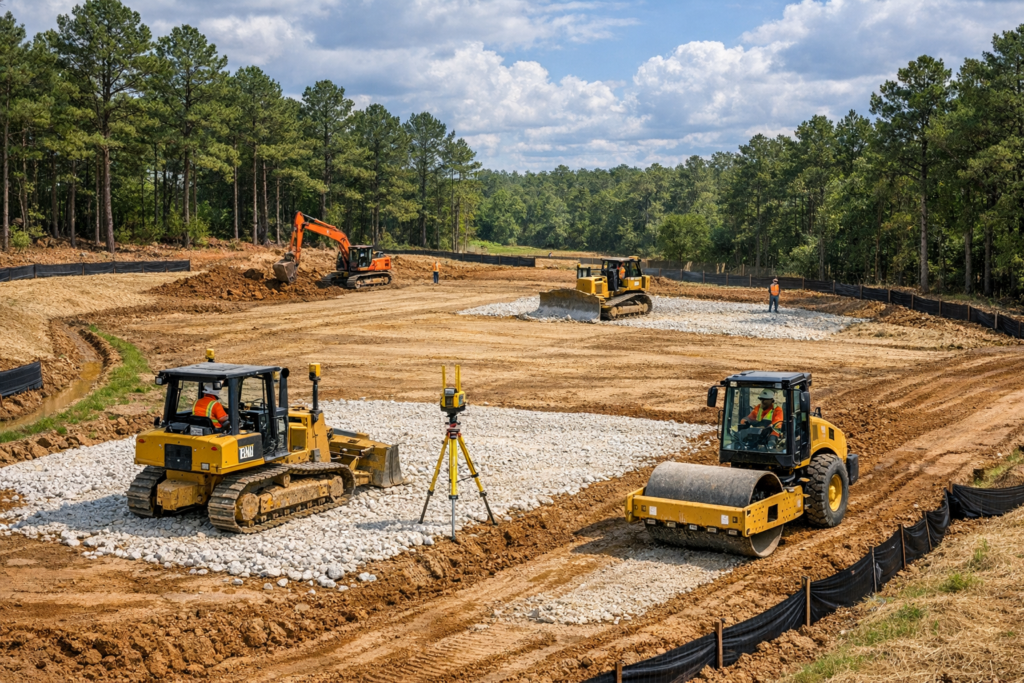
Every project begins with site clearing and excavation. Here in Palestine TX, that often means removing pine trees, hardwoods, brush, stumps, and sometimes old fencing or abandoned structures. Our crews use dozers, excavators, and forestry mulchers to strip the building envelope down to bare soil. This phase also includes establishing site access and haul roads so that material trucks and equipment can move safely in and out of the property without tearing up your driveway or your neighbor’s land.
During site clearing and excavation, we pay close attention to existing drainage patterns. East Texas receives an average of roughly 45 inches of rain per year, so understanding where water naturally flows across your property is critical before we reshape the terrain. We mark drainage corridors, identify low spots, and note any areas where standing water could become a problem later.
Cut and Fill Grading: Shaping the Land to Meet Your Plans
Once the site is cleared, we move into cut and fill grading. This is where the topography is reshaped to create a level or near-level surface at the correct elevation for your foundation. In cut and fill grading, soil is removed—or “cut”—from high spots and relocated—or “filled”—into low spots. The goal is to achieve the design elevation specified by your engineer or architect while minimizing the amount of outside material that needs to be hauled in.
House pad grading during this phase is measured in inches, not feet. Even small deviations can lead to uneven foundation loads, poor drainage, or costly rework. That is why our operators use elevation and laser grading technology to verify the pad surface as they work. Laser-guided systems allow us to hit tolerances within a fraction of an inch, ensuring the finished building pad is flat, uniform, and precisely at the target height.
Cut and fill work is also the stage where we address soil types. East Texas soils range from sandy loams to heavy, expansive clays. If the native material is not suitable for supporting a residential foundation pad, we may need to import select fill—engineered base material such as crushed limestone or stabilized clay—to build a more reliable pad. This decision is informed by geotechnical data and, when required, laboratory analysis of the on-site soil.
Compaction, Soil Stabilization, and Drainage: The Technical Details That Save You Thousands
The difference between a house pad that lasts a lifetime and one that leads to cracked walls and sticking doors often comes down to three technical elements: compaction and soil stabilization, proper drainage planning, and independent testing. These are the details where shortcuts cost homeowners the most money—and where our experience in East Texas house pad construction truly sets us apart.
Compaction and Soil Stabilization: Building a Rock-Solid Base
After grading, every layer of fill material must be compacted to a specific density. Compaction and soil stabilization eliminate air voids in the soil, increase its load-bearing capacity, and reduce the risk of future foundation settlement. We compact fill in controlled lifts—typically six to eight inches at a time—using vibratory rollers and sheepsfoot compactors suited to the soil type.
To verify that compaction meets engineering requirements, we coordinate compaction testing through a third-party geotechnical lab. The most common benchmark is the Standard Proctor test, which establishes the maximum dry density of a given soil at its optimum moisture content. Field technicians then compare on-site density readings to the Proctor test results. Most engineered building pad specifications require compaction to reach 95 percent of the Standard Proctor value or higher.
When native soil conditions are particularly challenging—such as the high-plasticity clays found in parts of Anderson County—soil stabilization techniques may be necessary. These can include:
– Lime treatment to reduce clay plasticity and increase strength.
– Cement stabilization for sandy or silty soils that lack cohesion.
– Importing select fill material to replace unsuitable native soil entirely.
– Geotextile fabric installation to separate weak subgrade layers from structural fill.
Each of these strategies adds to the up-front cost of dirt work for house pads, but the savings downstream are enormous. A properly stabilized and compacted pad dramatically reduces the likelihood of foundation settlement, which can cost tens of thousands of dollars to repair after a home is built.
Drainage Planning for House Pads: Keeping Water Where It Belongs
Water is the number-one enemy of residential foundations, and drainage planning for house pads deserves as much attention as compaction. During house pad grading, we establish a proper drainage slope—typically a minimum fall of six inches over the first ten feet away from the foundation perimeter—to direct surface water away from the structure.
Beyond surface grading, drainage planning for house pads may include:
– Swales or diversion ditches routed around the pad.
– French drains or sub-surface piping to intercept groundwater.
– Retention or detention areas to manage stormwater runoff, especially on larger or sloped lots.
– Culvert installation at driveway crossings to maintain natural drainage flow along road ditches.
Neglecting proper drainage slope is one of the most common causes of foundation problems in East Texas. Expansive clay soils swell when wet and shrink when dry, creating a cycle that can crack slabs and shift piers. By integrating robust drainage into every house pad construction project, we help break that cycle before it starts.
We also implement soil erosion control measures during and after construction. Silt fences, erosion blankets, and temporary seeding protect exposed soil from washing away during heavy rains—a frequent occurrence in Palestine TX—and keep sediment out of nearby creeks and waterways.
Common Risks, Permitting, and Why Cutting Corners Costs More
Over the years, we have been called to properties where a previous contractor or a well-meaning landowner tried to save money by skipping critical steps. The results are almost always more expensive to fix than it would have been to do the job right the first time. Here are the most common risks we see, along with guidance on the construction timeline and permitting process.
Foundation Settlement and Structural Issues
Foundation settlement occurs when the soil beneath a slab or pier system compresses unevenly over time. The root causes almost always trace back to inadequate compaction, improper fill material, or poor drainage. Signs include:
– Cracks in interior drywall or exterior brick.
– Doors and windows that stick or no longer close properly.
– Visible gaps between walls and ceilings or floors.
– Uneven or sloping floors.
Repairing foundation settlement after a home is built can easily cost $10,000 to $30,000 or more, depending on severity. A professionally engineered building pad with verified compaction testing and proper drainage planning virtually eliminates this risk. It is the clearest example of how smart house pad construction saves you thousands.
Construction Timeline and Permitting in Palestine TX
Many first-time home builders underestimate the time and paperwork involved in house pad site prep. In Palestine TX and the surrounding Anderson County area, you will typically need:
– A building permit from the city or county, depending on your property’s jurisdiction.
– A septic permit from the Texas Commission on Environmental Quality (TCEQ) if you are outside municipal sewer service.
– Possible floodplain development permits if any portion of your property falls within a FEMA-designated flood zone.
– Compliance with local stormwater and soil erosion control ordinances.
Construction timeline and permitting requirements vary, but a typical house pad construction project—from initial land clearing and dirt work services through final compaction testing and pad acceptance—takes two to four weeks for a standard residential lot. Larger or more complex sites, particularly those requiring significant cut and fill or imported fill material, may take longer.
We handle the logistics of construction timeline and permitting coordination as part of our turnkey service. Our familiarity with local officials, inspectors, and engineering firms in East Texas means fewer delays and a smoother path from raw land to ready build.
Site Access and Haul Roads: A Detail Many Overlook
If heavy equipment and material trucks cannot reach your building site efficiently, costs escalate fast. Establishing proper site access and haul roads early in the project protects your property, keeps delivery schedules on track, and prevents damage to county roads that could result in fines or repair obligations. We evaluate access needs during our initial site visit and include haul road construction or improvement in our scope of work when necessary. Strong site access and haul roads also benefit every trade that follows us—concrete, framing, roofing—so the savings compound throughout the entire build.
Why Palestine TX Homeowners Choose West’s Services Dozer & Construction LLC
East Texas house pad construction demands a contractor who understands the region’s unique soil conditions, climate, and regulatory landscape. That is exactly what we deliver at West’s Services Dozer & Construction LLC. Our team lives and works in this area, and we bring that local knowledge to every project.
Full-Service Land Clearing and Dirt Work Services
We are more than just a dozer and excavation contractor. West’s Services Dozer & Construction LLC provides comprehensive land clearing and dirt work services that cover every phase of house pad site prep:
– Forestry mulching, tree removal, and brush clearing.
– Topsoil stripping and stockpiling.
– Cut and fill grading with GPS and laser-guided equipment.
– Select fill delivery, placement, and compaction.
– Elevation and laser grading to engineered tolerances.
– Drainage design, swale construction, and culvert installation.
– Soil erosion control installation and maintenance.
– Final grading and pad certification coordination.
Whether you are building a single-family home on five acres outside Palestine TX or developing multiple lots in a new subdivision, our land clearing and dirt work services scale to meet your needs.
Local Expertise You Can Trust
When homeowners search for house pad construction near me, they are looking for a contractor who will show up, communicate clearly, and stand behind the work. West’s Services Dozer & Construction LLC has built our reputation on exactly those values. We provide transparent estimates, explain every step of the process, and keep you informed as the project progresses.
Our dozer and excavation contractor team knows the red and grey clays of Anderson County, the sandy loams along the Trinity River bottoms, and the ironstone layers that can surprise an out-of-town operator mid-dig. That familiarity means fewer change orders, more accurate bids, and a finished residential foundation pad that performs exactly as designed.
We also maintain strong relationships with local geotechnical engineers, surveyors, and building officials, so when compaction testing is needed or a permit question arises, we can get answers fast and keep your project on schedule.
Saving You Thousands—Not Just Today, but for Decades
Smart house pad construction is an investment that pays dividends long after the last piece of equipment leaves your property. A properly built building pad construction project means:
– No costly foundation repairs down the road.
– Lower risk of water intrusion and mold issues.
– A smoother, faster home construction process for your builder.
– Higher resale value because the home sits on a verified, engineered foundation pad.
– Peace of mind every time it rains.
East Texas house pad construction done right is the foundation—literally and figuratively—of a home that stands strong for generations. We take enormous pride in delivering that kind of quality to every homeowner we serve in Palestine TX and the surrounding communities.
Ready to Turn Your Raw Land into a Build-Ready Homesite?
From the first tree we clear to the final compaction test we coordinate, our goal at West’s Services Dozer & Construction LLC is to hand you a finished house pad that meets or exceeds every engineering specification, drains flawlessly, and gives your builder the perfect platform to construct the home you have been dreaming about. We have seen firsthand how professional house pad construction saves homeowners thousands of dollars in avoided repairs, reduced construction delays, and long-term structural integrity.
If you own land in Palestine TX or anywhere in East Texas and you are ready to take the first step toward building your home, we would love to talk. Reach out to our team today for a free on-site consultation and estimate. Visit us at https://westsdozer.com/ to learn more about our services, see photos of completed projects, and get in touch. Let us show you why so many homeowners trust West’s Services Dozer & Construction LLC to get the job done right—the first time.