
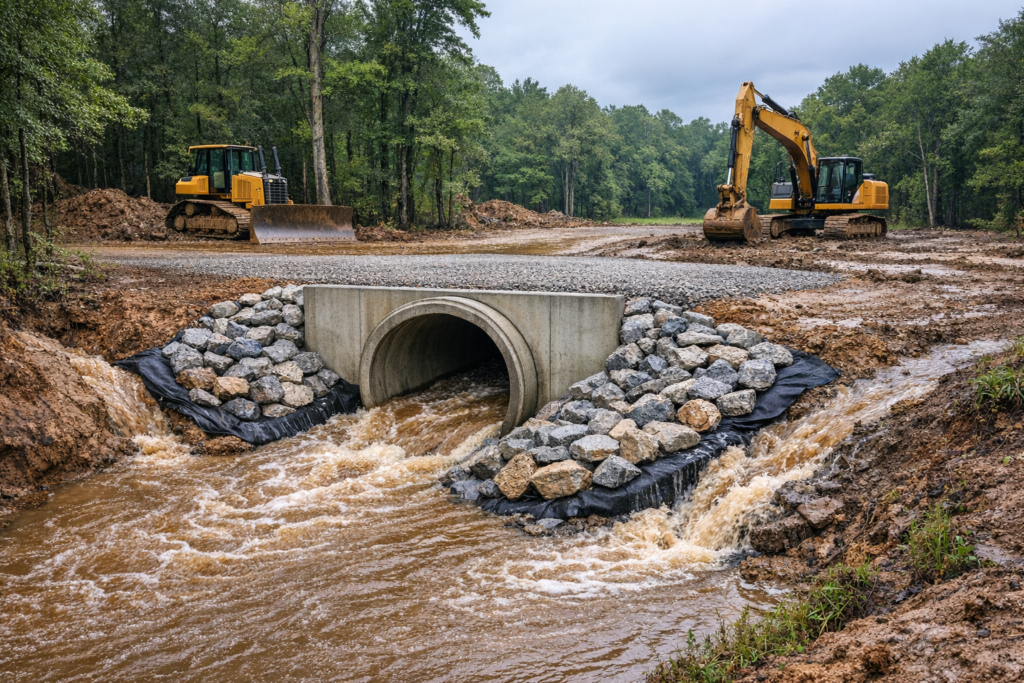
Every spring and fall in Palestine TX, heavy rains roll through Anderson County and turn peaceful ditches into raging channels of muddy water. We have seen it time and again on rural properties, ranch roads, and residential driveways across East Texas. One solid downpour is all it takes to wash out a crossing, strand equipment on the wrong side of a creek, or turn a gravel driveway into a muddy trench. The good news is that a properly engineered culvert installation solves this problem for decades, not just seasons. At West’s Services Dozer & Construction LLC, we have spent years perfecting the art and science of culvert installation in East Texas, and we are passionate about helping landowners protect their property with drainage solutions that actually last. In this guide, we will walk you through everything you need to know, from choosing the right pipe to meeting county regulations, so you can make a confident, informed decision.
Why a Proper Driveway Culvert Matters More Than You Think
A driveway culvert is not just a piece of pipe buried under gravel. It is the single most important piece of infrastructure connecting your property to the road, and when it fails, everything else becomes harder. We have responded to calls from homeowners in Palestine TX who could not get their trucks out for work, ranchers who could not reach livestock, and landowners who watched topsoil wash away because an undersized or poorly installed driveway culvert collapsed under pressure.
The Real Cost of a Washout
When a driveway culvert fails, the damage extends far beyond the crossing itself. Erosion eats into the roadbed, destabilizes fence lines, and can undermine utility poles and mailbox posts. Sediment from a blown-out crossing flows downstream and clogs neighbors’ culverts, creating a chain reaction of drainage problems. We have seen repair bills that cost three or four times more than the original culvert installation would have cost if it had been done correctly from the start.
Here is what a washout typically affects:
– The driveway surface, which must be rebuilt with fresh gravel or base material
– Surrounding grading and drainage, which must be re-established to direct water properly
– Downstream ditches and neighboring properties, which may require erosion control repairs
– Access for emergency vehicles, school buses, and delivery trucks, which is a road and driveway safety issue that many people overlook until it is too late
How a Driveway Culvert Actually Works
At its core, a driveway culvert channels water from one side of a road or driveway to the other without allowing the crossing surface to wash away. Water enters the inlet, travels through the pipe or box structure, and exits the outlet. The entire system depends on proper culvert sizing, correct slope, solid culvert bedding and backfill, and adequate erosion control at both ends. When any one of those elements is missing, performance degrades quickly. A driveway culvert that is too small will dam water during a storm, and that pooled water will eventually overtop the driveway or find a path around the pipe, eroding the fill material on both sides. We design every driveway culvert we install to handle the specific watershed, soil type, and storm intensity common to Palestine TX and the surrounding East Texas region.
Choosing the Right Culvert Type and Material for Your Property
One of the most common questions we hear is, “What kind of pipe should I use?” The answer depends on your budget, the volume of water you need to move, the weight of traffic crossing over the pipe, and how long you want the installation to last. We work with every major culvert type used in residential, agricultural, and commercial applications, and we are happy to walk you through the pros and cons of each.
Concrete Culvert
A concrete culvert is the gold standard for durability and load-bearing capacity. Reinforced concrete pipe, often abbreviated RCP, handles heavy truck traffic, resists corrosion from acidic East Texas soils, and can last 75 to 100 years with minimal long-term maintenance and inspection. We frequently recommend a concrete culvert for ranch and farm road culverts that see heavy equipment, timber trucks, or cattle trailers. The main tradeoff is cost: concrete culvert sections are heavier and require larger excavation equipment to set in place, which increases the upfront investment. However, when you factor in the lifespan, a concrete culvert often delivers the lowest cost per year of any material on the market.
Corrugated Metal Culvert
A corrugated metal culvert, typically made from galvanized steel or aluminized steel, is a popular choice for rural driveway drainage projects and county road crossings. It is lighter than concrete, easier to transport, and generally less expensive to purchase. We install corrugated metal culvert pipes in a wide range of diameters, from 12 inches for minor swales up to 60 inches or more for significant creek crossings. The corrugation pattern gives the pipe structural strength, and modern coatings extend service life considerably. That said, a corrugated metal culvert is more vulnerable to rust and corrosion over time than concrete or plastic, especially in areas where water sits inside the pipe for extended periods. We always factor soil pH and typical water chemistry into our recommendation.
Plastic Culvert Pipe and HDPE Culvert
High-density polyethylene, commonly called HDPE culvert or simply plastic culvert pipe, has gained significant ground in the culvert market over the past two decades. It is lightweight, corrosion-proof, and relatively affordable. A plastic culvert pipe is an excellent option for rural driveway drainage where traffic loads are moderate, such as personal vehicles and light trucks. We also use HDPE culvert for pond and lake overflow culverts because the smooth interior wall provides superior culvert drainage capacity compared to corrugated metal of the same diameter. The smooth bore means less friction loss and faster flow, which is critical when you need to move a large volume of water quickly during a storm event.
Box Culvert
For larger crossings where a round pipe simply cannot move enough water, we turn to the box culvert. A box culvert is a rectangular structure, usually precast concrete, that provides a wide, flat channel for high-volume flow. We have installed box culvert structures on ranch and farm road culverts that span wide, flat creek bottoms and on commercial site entrances where stormwater management demands maximum capacity. A box culvert requires more extensive culvert excavation and a more robust foundation, but it delivers unmatched performance for challenging sites.
Culvert Installation Done Right: Our Step-by-Step Process in Palestine TX
At West’s Services, we follow a repeatable, standards-driven process for every culvert installation in East Texas. Cutting corners during any phase leads to premature failure, so we are meticulous from start to finish. Here is how we approach a typical project.
Site Evaluation, Hydraulic Analysis, and Culvert Sizing
Every successful culvert installation begins with understanding the water. Before we fire up a single piece of excavation equipment, we evaluate the watershed area that drains to the crossing, the slope of the channel, the soil type, and the historical storm data for Palestine TX. This hydraulic analysis tells us how much water the culvert needs to handle during a design storm, typically the 25-year or 50-year event, depending on the application and any state and county culvert regulations that apply.
From the hydraulic analysis, we determine the correct culvert sizing. Pipe diameter is the most critical variable: too small, and the pipe cannot keep up with peak flows; too large, and you waste money and may create low-flow sediment problems inside the pipe. Culvert sizing also accounts for the pipe material’s roughness coefficient, the slope at which the pipe will be installed, and whether the pipe will flow full or partially full during the design storm. We often prepare simple flow calculations using widely accepted methods like the Manning equation, which the Federal Highway Administration and the Texas Department of Transportation both endorse for culvert design. This level of culvert design work separates a professional installation from a guess-and-hope approach.
Land Clearing and Dirt Work, Excavation, and Bedding
Once we know the culvert sizing and material, we mobilize our heavy equipment to the site. Most projects begin with land clearing and dirt work to remove trees, brush, and debris from the installation corridor. We use dozers, excavators, and skid steers suited to the job size, and our operators are experienced with the tight quarters and soft soils common to culvert excavation in East Texas.
Culvert excavation involves digging a trench to the correct depth, width, and grade. The trench bottom must be smooth and uniformly sloped so the pipe does not develop low spots that trap sediment and water. Next comes culvert bedding and backfill, which is arguably the most underappreciated step in the entire process. We place a layer of select granular material, typically clean sand or crushed stone, in the bottom of the trench to create a stable, well-drained bed for the pipe. The pipe is set on this bedding at the specified grade, and then we place backfill material in lifts around and over the pipe, compacting each lift to achieve the density required by culvert installation standards.
Proper culvert bedding and backfill prevents the pipe from settling unevenly, cracking under load, or shifting during high-flow events. We have pulled out failed culverts that were simply dropped into a muddy ditch with no bedding at all, and the result is always the same: a cracked, misaligned pipe that leaks, clogs, and eventually collapses.
Grading and Drainage, Erosion Control, and Finishing
After the pipe is in place and backfilled, we rebuild the driveway surface and fine-tune the grading and drainage around the crossing. Water must be directed into the inlet smoothly and discharged from the outlet without scouring the downstream channel. We install erosion control measures at both ends of the culvert, which may include riprap, concrete headwalls, gabion baskets, or geotextile-lined energy dissipaters, depending on the flow velocity and soil conditions.
Erosion control at the outlet is especially critical. Fast-moving water exiting a culvert can scour a deep hole in seconds during a heavy rain, undermining the pipe and the road above it. We size our erosion control installations based on the same hydraulic analysis we used for culvert sizing, so the protection matches the expected energy of the discharge.
We also address grading and drainage on the surface of the driveway itself. Crown, cross-slope, and ditch lines must work together to keep rainwater moving off the driving surface and into the culvert rather than pooling on top of it. This attention to grading and drainage is what separates a culvert installation that lasts 50 years from one that starts failing after the first heavy rain.
Permits, Regulations, and Long-Term Maintenance
Culvert Permits and County Regulations
In Anderson County and throughout East Texas, culvert permits are typically required for any new or replacement driveway culvert that connects to a county road ditch. The county road department may specify minimum pipe diameters, material types, and installation depths to ensure the new crossing does not impede drainage along the public right-of-way. Ignoring culvert permits can result in fines, required removal, or liability if your installation causes flooding on neighboring property.
We handle the permitting process for our clients as part of our standard scope of work. We are familiar with the state and county culvert regulations that apply in Palestine TX, Anderson County, and surrounding jurisdictions, and we ensure every installation meets or exceeds those requirements. Our goal is zero surprises for the landowner, from the first phone call to the final inspection.
Beyond local county regulations, certain projects near waterways classified as Waters of the United States may require federal permits under the Clean Water Act, administered by the U.S. Army Corps of Engineers. Pond and lake overflow culverts that discharge into regulated streams can also trigger additional review. We help our clients navigate these requirements so that every culvert installation in East Texas is fully compliant.
Long-Term Maintenance and Inspection
Even the best culvert installation needs periodic attention. We recommend that property owners inspect their culverts at least twice a year, once before the spring rain season and once before fall, to check for debris blockages, inlet and outlet erosion, and structural damage. Long-term maintenance and inspection is simple but essential:
– Walk both ends of the culvert and look for sediment buildup, trash, or animal nests blocking the opening.
– Check the outlet for scour holes or erosion that could undermine the pipe.
– Look for sinkholes or depressions in the driveway surface above the pipe, which may indicate a void beneath the road caused by inadequate culvert bedding and backfill or pipe joint separation.
– After any major storm, inspect the crossing promptly. Early detection of problems allows for inexpensive repairs before damage escalates.
We offer long-term maintenance and inspection services for clients who prefer professional oversight. Regular professional inspections extend the service life of every culvert type, whether it is a concrete culvert, a corrugated metal culvert, or a plastic culvert pipe.
Pond and Lake Overflow Culverts
Our work does not stop at driveway crossings. We design and install pond and lake overflow culverts that protect earthen dams, control water levels, and prevent catastrophic spillway failures. A pond and lake overflow culvert must be engineered with the same care as a road crossing, including proper culvert design, correct culvert sizing, and robust erosion control at the discharge point. Landowners with stock ponds, fishing lakes, or irrigation reservoirs across Palestine TX trust us because we understand the unique stormwater management challenges these structures present. A failed overflow culvert can breach a dam, flood downstream pastures, and destroy years of investment in a matter of hours. We treat every pond and lake overflow culvert project with the seriousness it deserves.
Ready to Protect Your Property? Let Us Help.
A well-planned culvert installation is one of the most valuable investments a property owner in Palestine TX can make. It protects your driveway, your land, your livestock, and your peace of mind every time the sky opens up. We have covered the importance of correct culvert sizing, the differences between a concrete culvert, a corrugated metal culvert, and a plastic culvert pipe, and the critical role that culvert bedding and backfill, grading and drainage, and erosion control play in a long-lasting installation. We have also highlighted the need for culvert permits, compliance with state and county culvert regulations, and consistent long-term maintenance and inspection.
At West’s Services Dozer & Construction LLC, culvert installation in East Texas is not a side job for us; it is a core part of what we do alongside land clearing and dirt work, ranch and farm road culverts, rural driveway drainage solutions, and stormwater management projects of all sizes. Our crew brings the right excavation equipment, the right experience, and the right commitment to culvert installation standards to every job site.
If you are dealing with washouts, flooding, or poor drainage on your property, we would love to talk. Reach out to us today at westsdozer.com to schedule a free site evaluation. Let us show you why landowners across Palestine TX and East Texas trust West’s Services for culvert installation that actually lasts.