
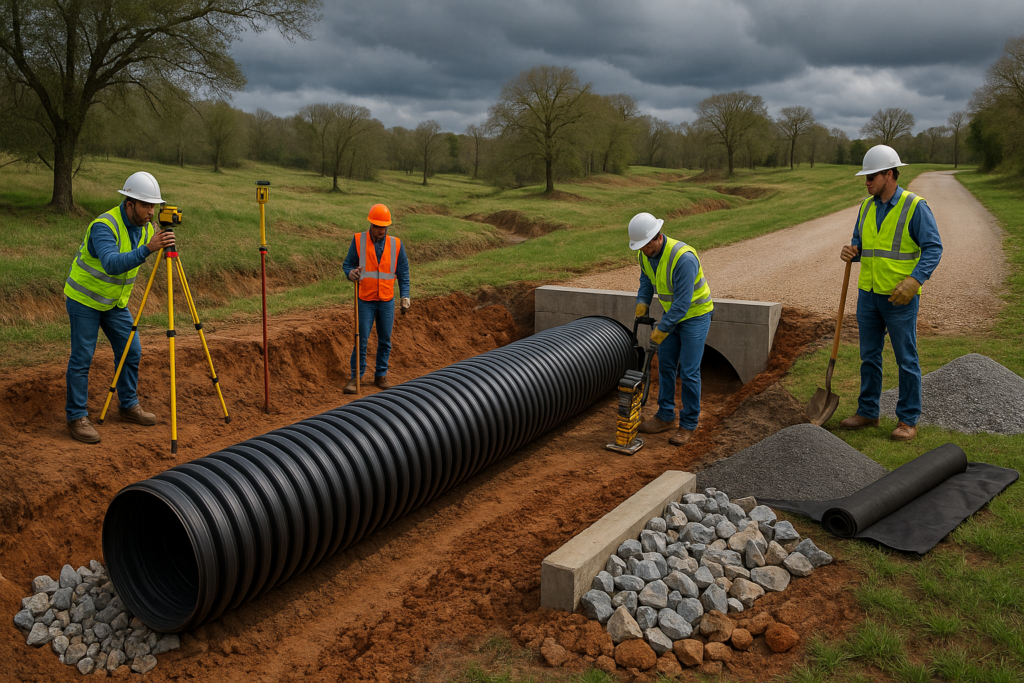
Why Smart Culvert Installation Matters For Your Driveway
When heavy rain hits our corner of East Texas, it doesn’t take long to see which driveways were built right and which ones weren’t. We have seen countless driveways in Palestine TX washed out, rutted, or completely impassable because water had nowhere smart to go. That’s where smart culvert installation comes in. When we design and install a culvert correctly, we’re not just putting a pipe in the ground; we’re creating a controlled pathway for stormwater that protects everything around it.
A well‑planned culvert installation does three big things for a driveway:
– It moves water under your drive instead of over it.
– It reduces erosion around your ditches and road edges.
– It extends the life of your driveway surface, whether it’s gravel, asphalt, or concrete.
We see a lot of DIY attempts around Palestine TX where the culvert is too small, laid too high, or has no proper inlet and outlet protection. The result is almost always the same: standing water, soft shoulders, and eventually a blowout during a big storm. When our team lays out a culvert, we look at the whole drainage picture on your property, not just the spot where you drive in.
We also understand that in our region, local county guidelines and Texas drainage standards matter. A culvert that blocks natural flow or pushes water onto a neighbor’s land can turn into a legal headache. That’s why, before we ever dig, we study:
– Existing roadside ditches and natural swales.
– Upstream and downstream drainage patterns.
– Driveway height and slope.
– Soil conditions and existing erosion problems.
By treating culvert installation as part of a complete drainage system instead of a single task, we help homeowners keep their driveways solid, safe, and accessible year‑round. In Palestine TX, where sudden downpours are just part of life, that extra planning makes all the difference between a driveway that fails every few years and one that stays strong for the long haul.
Reading Your Land: How We Plan Driveway Drainage In Palestine TX
Before we ever bring a dozer or excavator onto your place, we walk the site and read the land. Our team has learned that successful culvert installation in Palestine TX always starts with understanding how water wants to move naturally. If we fight that natural flow, the driveway will lose every time. If we work with it, the driveway stays put and your ditches stay stable.
We start by looking at the big picture. That usually means walking from the highest point of your property down toward the lowest, following natural low spots and ditches. We ask ourselves:
– Where is the water coming from?
– Where is it trying to go?
– What obstacles or pinch points exist along the way?
If you already have areas that stay soggy after a storm, we take note. Those wet spots tell us a lot about soil type, compaction issues, and whether your existing ditch or driveway is restricting flow. In parts of Anderson County, we deal with clay soils that hold water and can make driveway bases weak if drainage isn’t handled correctly. That’s one more reason smart culvert installation is so important here.
Key Drainage Factors We Evaluate
When we design a driveway crossing and culvert installation, we focus on several core factors:
– Slope across the driveway
We make sure the driveway has a gentle crown or cross‑slope so water sheds off the surface instead of pooling in the wheel tracks. A properly crowned gravel drive, paired with a culvert at the low point, resists rutting and washouts far better than a flat surface.
– Ditch depth and shape
We confirm that roadside or property ditches are deep and wide enough to carry peak flows during a heavy storm. If the ditch is too shallow or too flat, water will back up toward your driveway instead of feeding into the culvert.
– Inlet and outlet elevations
The inlet should sit slightly lower than the ditch flow line so water is naturally drawn into the culvert. The outlet must be low enough that water can exit freely, with enough fall so sediment doesn’t build up inside the pipe.
– Soil stability
In areas with softer soils, we may recommend additional rock, geotextile fabric, or concrete headwalls to stabilize the driveway approach and protect the ends of the culvert.
Matching Culvert Size To Real‑World Storms
We’ve learned that “rule of thumb” sizing can be risky, especially in a place like Palestine TX where a single thunderstorm can dump inches of rain in a short time. When we size a culvert, we look at:
– The size of the drainage area feeding your ditch.
– How steep that contributing area is.
– The type of ground cover (woods, pasture, pavement).
– Local rainfall intensity data.
From there, we choose a diameter that can handle real‑world peak flows, not just average showers. In many residential driveway situations, that means we end up using a larger pipe than what was there originally. It might cost a bit more up front, but we’ve watched too many undersized pipes plug up and blow out during big storms to cut corners on size.
By taking the time to read your land and design the drainage right, we set the stage for a driveway and culvert installation that stands up to Texas weather instead of failing at the first big test.
Best Practices For Long‑Lasting Culvert Installation
Once we’ve got a solid drainage plan, the real work begins. We’ve repaired a lot of failed culvert installations around Palestine TX, and we see the same mistakes over and over: pipes laid almost flat, no bedding under the culvert, ends left unprotected, and driveway material dumped on top without compaction. To stop driveway washouts, we follow a set of best practices that we don’t compromise on.
Choosing The Right Culvert Material
Each property and budget is different, so we walk our customers through the main culvert material options and where we like to use them:
– Corrugated HDPE (plastic)
Lightweight, durable, and resistant to corrosion. This is our go‑to for many residential driveway culvert installation projects in Palestine TX. It handles our acidic soils well and is easy to work with on tighter sites.
– Corrugated metal pipe (CMP)
Stronger in some structural situations and still common along county roads, but it can be more susceptible to rust in certain soil and water conditions. We make sure to evaluate whether CMP makes long‑term sense before recommending it.
– Reinforced concrete pipe (RCP)
Very durable and heavy, excellent for high‑load situations and long‑term public infrastructure. On residential projects, we sometimes use concrete end treatments or headwalls with plastic pipe to get strength where it’s most needed.
We never choose material on price alone. We weigh expected water volume, soil type, traffic load, and how accessible the site will be for future maintenance.
Proper Bedding, Cover, And Compaction
Even the best pipe will fail if the soil around it isn’t installed correctly. When we install a driveway culvert, we follow a process step by step:
1. Excavate a trench with enough depth for bedding and cover.
2. Grade the trench bottom to a consistent slope so water keeps moving.
3. Place a layer of compacted gravel or suitable bedding material under the pipe.
4. Set the culvert at the correct grade, checking elevations carefully.
5. Backfill evenly along both sides of the pipe in thin lifts, compacting as we go.
6. Build the driveway base over the top, maintaining the required minimum cover.
Skipping compaction or backfilling only on one side is a recipe for pipe deformation, settlement, and surface cracking. We’d rather take a little more time during installation than have you face a major repair later.
Protecting Inlets, Outlets, And Driveway Edges
One of the big secrets to stopping driveway washouts is protecting the areas where water enters and exits the culvert. In Palestine TX, a hard rain can turn an unprotected pipe end into a powerful erosion point. To prevent that, we often add:
– Rock riprap or large stone at the outlet to break up flow and limit scour.
– Concrete or rock headwalls to stabilize the pipe ends and driveway shoulders.
– Flared end sections to help guide water smoothly into the pipe.
– Erosion control fabric on nearby slopes until vegetation gets established.
We also pay close attention to how the driveway surface meets the culvert. A sharp drop‑off or poorly compacted shoulder can crumble under vehicle weight, and once the edges break, water starts cutting underneath the driveway. By building up and compacting the shoulders with the right material, we keep the driveway structure tied together.
All of these steps work together. When we combine the right material, correct sizing, careful grading, and strong end protection, we create a culvert installation that works with our Texas weather instead of failing because of it.
Preventing Washouts: Maintenance, Upgrades, And Local Know‑How
A well‑built culvert installation should serve your property for many years, but no drainage system is completely “set it and forget it.” We’ve seen perfectly good culverts in Palestine TX fail early simply because they were never inspected, cleaned, or upgraded as conditions changed. Our goal is to give homeowners the knowledge to keep their driveway crossings in top shape without constant stress.
Simple Maintenance Steps Homeowners Can Take
We like to walk customers through a few easy checks they can do after big storms:
– Inspect the inlet and outlet
Look for leaves, branches, trash, or gravel that might be blocking flow. If more than about one‑third of the opening is clogged, flow rates can drop fast, and water will start looking for another path—usually over or around your driveway.
– Watch how water behaves during a heavy rain
If you feel safe doing so, step outside during a storm and observe the flow. Is water entering the culvert smoothly, or is it spilling over the driveway? Is the outlet discharging cleanly, or is water backing up in the ditch?
– Check driveway ruts and soft spots
Minor ruts or soft areas just above the culvert often signal that water is getting trapped under the surface or that shoulders are starting to fail. Catching those issues early lets us fix grading and compaction before a full washout occurs.
We also recommend a simple seasonal routine:
– Clear vegetation that blocks ditches and culvert ends.
– Remove sediment buildup at the inlet and outlet.
– Add gravel or touch‑up grading on the driveway crown as needed.
These small tasks go a long way toward keeping your culvert installation working properly in our Palestine TX climate.
When It’s Time To Upgrade Or Replace Your Culvert
Sometimes a culvert simply outlives its usefulness. We’ve been called to many properties where the driveway has washed out repeatedly, even after patching and adding more rock. In those cases, the real problem is often:
– An undersized culvert for today’s rainfall and runoff conditions.
– A pipe set too high, so water runs over the driveway instead of through the culvert.
– Severe rust or deterioration on older metal pipes.
– Erosion around the ends that’s undermined the driveway base.
When we inspect an older driveway crossing, we don’t just look at the pipe itself. We study the whole system to see what’s failing and why. Sometimes the solution is as simple as cleaning and adding rock around the outlet. Other times, the reality is that the culvert needs to be replaced with a larger diameter, new material, or a redesigned approach with stronger shoulders and better headwalls.
We also pay attention to how growth and improvements around a property change runoff. For example:
– New shop buildings or barns can increase hard surfaces that shed water faster.
– Removing trees or clearing brush can increase the speed of runoff into a ditch.
– Neighboring development can alter how water reaches your driveway.
If your driveway in Palestine TX has started washing out more often in recent years, those changes may be part of the story. In those situations, an upgraded culvert installation paired with improved ditch shaping and driveway grading can break the cycle of repeated repairs.
For homeowners who want to dig deeper into drainage and culverts, the Texas Department of Transportation and local county road manuals often share helpful public resources on stormwater and driveway crossing guidelines. Understanding those standards helps us design systems that work not just for a single storm, but for the long‑term health of the road and surrounding land.
In the end, our passion is helping property owners in and around Palestine TX enjoy safe, reliable access to their homes, farms, and businesses in every season. With smart culvert design, careful installation, and simple maintenance, we can stop driveway washouts before they ever start.
If you’re dealing with recurring ruts, standing water, or a failing driveway crossing, we’re here to help. Our team at West’s Services Dozer & Construction LLC can evaluate your site, design a smarter drainage plan, and install a culvert system that’s built to last in real Texas weather. To learn more about our culvert installation services or to request a site visit, you can contact us directly at https://westsdozer.com/.